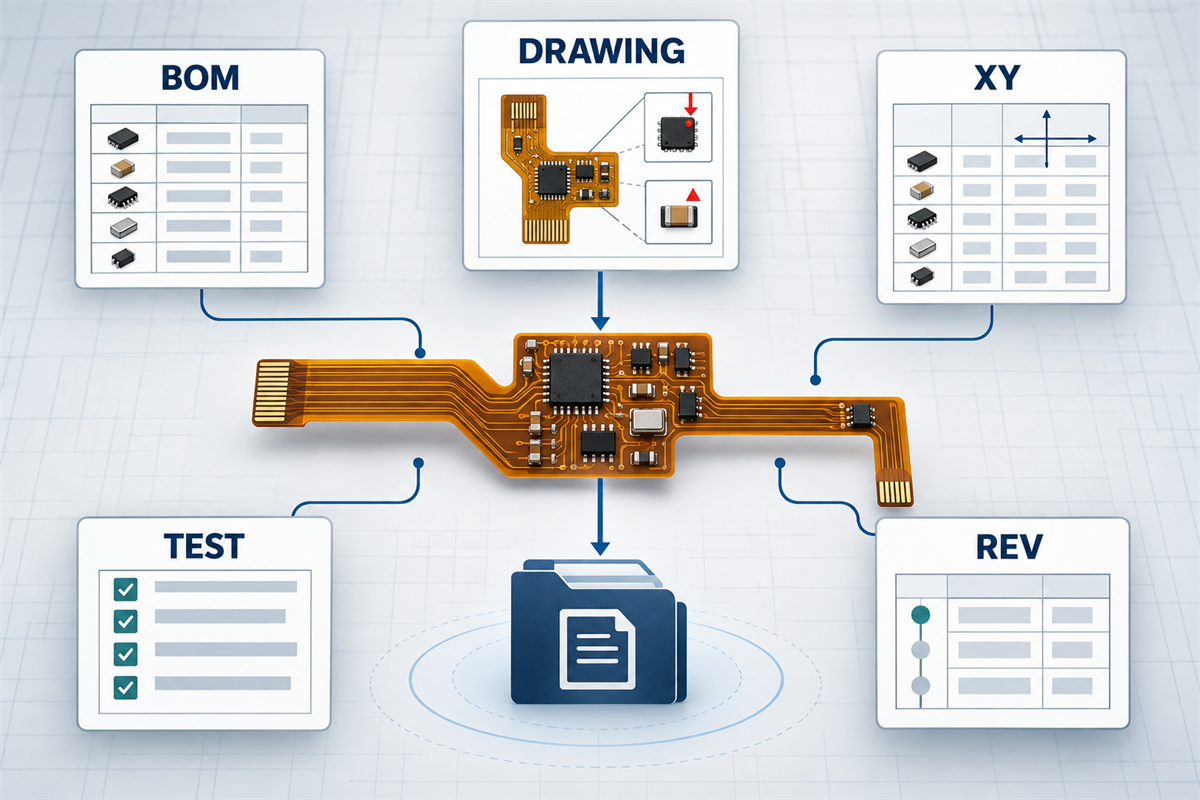
An FPC assembly RFQ is not complete when it contains only a BOM and Gerber files. A reliable quotation baseline connects the flexible-circuit fabrication data, component sourcing scope, placement coordinates, assembly drawing, mechanical constraints, test requirements, and revision status. If those items describe different product revisions, the quote may look complete while its assumptions remain unclear.
1. Define the FPC Assembly Quotation Scope First
Start by stating what the supplier is being asked to quote. The scope may include bare flexible-circuit fabrication plus component sourcing and assembly, or it may cover assembly of customer-supplied FPCs. Components may be fully sourced, fully consigned, or split between the customer and a project-matched manufacturing partner. These models create different review questions, so the responsibility for each item should be explicit.
Product scope
Identify the assembly part number, revision, requested quantities, delivery form, and whether the quote covers prototypes, a pilot build, or a later production phase. Quantities are project inputs, not promises of price, capacity, or lead time.
Supply responsibility
Mark bare FPCs, components, special materials, fixtures, mating hardware, firmware, and packaging as customer-supplied, supplier-sourced, supplier-to-review, or excluded.
If the project still needs a fabrication-focused data list, use the FPC RFQ requirements guide. The assembly package should reference that baseline instead of duplicating or contradicting it.
2. Create One Controlled RFQ Baseline
Put the file list at the front of the package. A simple manifest can name the fabrication dataset, fabrication drawing, BOM, approved-vendor or alternate list, pick-and-place file, assembly drawing, paste data when supplied, mechanical model, test specification, firmware, and packaging instruction. Record a revision, date, or controlled identifier for each item.
Choose a governing product revision and explain which dataset controls each type of information. For example, the fabrication drawing may control stack-up and mechanical tolerances, while the electronic artwork controls copper geometry. The BOM, centroid data, and assembly drawing must use the same reference designators. If a conflict exists, list it as an open item rather than choosing one interpretation without approval.
3. Provide the Fabrication Data the Assembly Review Depends On
The assembly review needs enough bare-board information to understand pads, outline, finished thickness, stiffeners, surface finish, tooling features, arrays, and mechanical interfaces. Provide the agreed artwork and drill data together with the fabrication drawing and any required stack-up or performance notes. Gerber may be used with supporting documents; ODB++ or IPC-2581 may be used where the project and receiving systems support them. No single format should be described as universally required.
The official Ucamco Gerber page publishes the current Gerber Layer Format specification. IPC lists IPC-2581C as the current revision of its printed-board assembly manufacturing-description data-transfer standard, while the official ODB++ resource describes a structured design-to-manufacturing dataset for fabrication, assembly, and test. These references define formats; they do not remove the need to agree which files and revisions govern the RFQ.
4. Make the BOM Quotable and Sourcing-Ready
For each fitted item, provide a unique reference designator, quantity per assembly, manufacturer name, manufacturer part number, and the sourcing responsibility. Include the approved alternate or substitution rule when alternates are allowed. Mark do-not-populate items consistently in the BOM and assembly drawing, using the project’s chosen DNP or DNI convention.
A package description such as “0603 resistor” or “FPC connector” may help review, but it does not replace an approved part number when package geometry, material, height, temperature rating, polarity, lifecycle, or mating compatibility matters. If the exact part is not released, label it customer-to-confirm or supplier-to-review and state whether the quotation may use an assumption.
- Separate customer-supplied parts from parts requested for sourcing.
- Identify approved alternates and who has authority to accept a substitution.
- Flag long-lead, controlled, programmed, moisture-sensitive, or otherwise handling-dependent items only when supported by approved component documentation.
- Keep quantities, reference designators, and fitted/not-fitted status consistent across files.
5. Make Pick-and-Place Data Agree With the Assembly Drawing
Centroid or pick-and-place data should identify the reference designator, X and Y coordinates, board side, rotation, units, and origin. Rotation conventions can differ between CAD libraries, exported files, and assembly systems, so a numeric angle should not be treated as self-explanatory. Provide a visual assembly drawing or controlled render that shows pin 1, polarity, connector orientation, diodes, LEDs, electrolytic capacitors, and other asymmetric parts.
The visual document is a cross-check, not a substitute for machine-readable placement data. If the drawing and coordinate file disagree, close the discrepancy before release. The FPC assembly DFM guide covers panel support, printing, placement, and reflow considerations; this RFQ checklist focuses on the information required to review and quote that work.
6. State Special Assembly Requirements as Requirements
Do not leave special operations inside informal email threads. Where applicable, specify the required solder alloy or customer-controlled material, cleaning or residue restrictions, adhesives, reinforcement, installed hardware, hand operations, connector mating, conformal coating, marking, or other project-controlled steps. Attach the governing drawing or specification and identify its revision.
These notes request review; they do not prove that every manufacturing partner has the required equipment or process. Feasibility, materials, tooling, workmanship criteria, and validation evidence remain subject to engineering review and confirmation for the actual project.
7. Define Inspection, Test, Programming, and Evidence
“Test required” is not a test specification. Define what is to be verified, the applicable limits, the test point or connector interface, who supplies mating hardware or fixtures, whether firmware is required, and what record should accompany the build. If an IPC acceptance standard or class is contractual, state the exact document revision, class, customer exceptions, and evidence expectation.
IPC’s release notice distinguishes J-STD-001J, which addresses soldering processes and materials, from IPC-A-610J, which addresses post-assembly acceptance. Naming either document is not automatic proof of compliance; it is a procurement requirement that must be agreed and applied. For method selection, see the FPC assembly inspection guide.
8. Include Mechanical, Array, Carrier, Depanelization, and Packaging Inputs
Flexible assemblies often depend on their supported state. State whether parts arrive or leave as single circuits, panels, arrays, or assembled units. Identify critical keep-outs, stiffener interfaces, connector datums, installed-form constraints, separation requirements, and packaging protection. If a carrier or support concept is already prescribed, include the approved drawing; otherwise mark support and tooling as items for review.
Packaging is also part of the quotation scope when exposed contacts, flex tails, tall components, pre-formed regions, or customer handling rules require protection. Describe the required delivery condition and evidence, without assuming a packaging method before the part and shipping route are reviewed.
9. Control Open Items and Quote-to-Order Changes
A useful open-item list uses four states: confirmed, supplier-to-review, customer-to-confirm, and excluded. Each item should have an owner and a closure record. This prevents an unanswered question from becoming an invisible quotation assumption.
After quotation, changes to the BOM, fabrication data, placement file, drawing, test method, firmware, tooling, or mechanical definition need an impact review. Do not assume the earlier quote still applies. Whether a change affects materials, tooling, cost, schedule, or validation depends on the specific project and must be confirmed.
FPC Assembly RFQ Engineering Checklist
| Package area | Information to include | Control question |
|---|---|---|
| Scope and revision | Assembly part number, revision, quantities, delivery form, file manifest, open-item list | Do all documents describe one quotation baseline? |
| Bare FPC | Agreed artwork/drill dataset, fabrication drawing, stack-up or thickness information, finish, stiffeners, outline, array data | Is the assembly team reviewing the same board that will be supplied? |
| Components | BOM, MPNs, reference designators, quantity, DNP/DNI, approved alternates, sourcing responsibility | Is every fitted item identifiable and authorized? |
| Placement | X/Y, side, rotation, units, origin, paste data if supplied, assembly drawing, polarity/orientation marks | Can machine data be checked against a controlled visual reference? |
| Process and mechanics | Special materials/operations, mechanical files, array/carrier assumptions, depanelization, installed form, packaging | Which items are requirements, and which still need review? |
| Inspection and test | Acceptance requirement, inspection scope, electrical/functional test, limits, firmware, fixtures, mating hardware, records | What must be verified, by whom, and with what evidence? |
Technical References
The article’s standards and data-format statements were checked against the IPC document revision table, IPC’s J-revision release notice, Ucamco’s official Gerber specification page, and the official ODB++ resource. These sources explain document roles and data formats. The actual contract revision, file format, acceptance class, test scope, and approved component documentation must still be stated for the project.
Prepare the Assembly Package for Review
FPCFAB can organize available FPC assembly files, identify missing or conflicting quotation inputs, and coordinate engineering and quotation review with a project-matched manufacturing partner. Materials, sourcing, tooling, assembly methods, inspection and test scope, cost, and schedule remain subject to project review and confirmation.