FPC cost is determined by the complete product specification, not by board dimensions alone. Two flexible printed circuits with a similar outline can have very different quotations if they use different layer counts, copper constructions, coverlay designs, stiffeners, surface finishes, dimensional tolerances, testing requirements, or production quantities.
For purchasing teams, the lowest unit price is not always the lowest total project cost. A quotation must also reflect tooling, engineering review, material availability, panel utilization, prototype risk, electrical testing, assembly support, yield, and delivery requirements. Understanding these factors helps customers prepare more complete RFQ packages and compare supplier quotations on a technically consistent basis.
This guide explains the ten main factors that influence flexible printed circuit pricing for prototype, pilot-run, and volume-production orders.
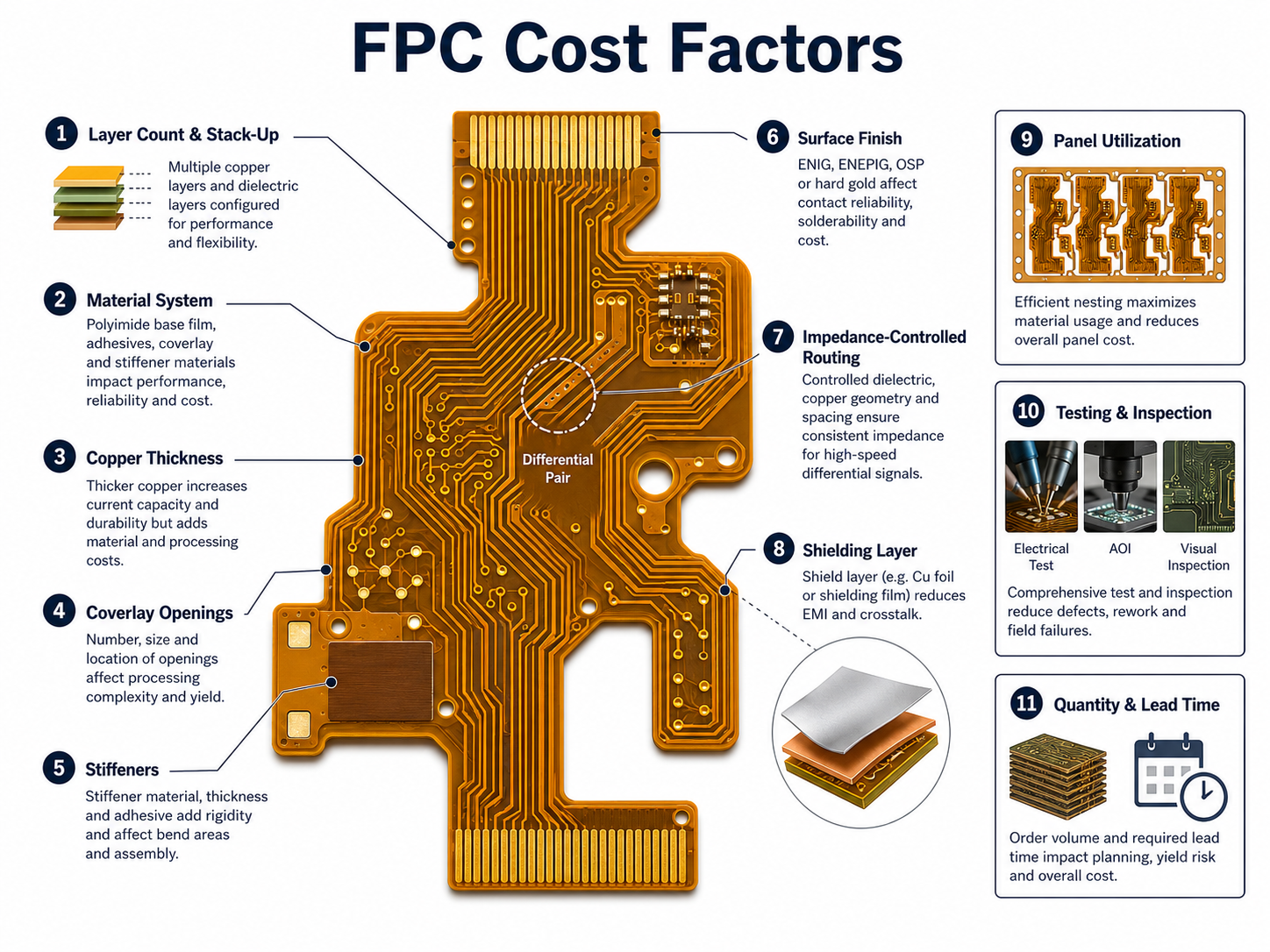
1. Layer Count and Stack-Up Complexity
Layer count is one of the first cost drivers in an FPC quotation. A single-sided flexible circuit usually requires fewer lamination, drilling, plating, imaging, and registration operations than a double-sided or multilayer construction.
However, layer count alone does not fully describe manufacturing difficulty. The complete stack-up must also be reviewed, including:
- Single-sided, double-sided, or multilayer construction
- Adhesive-based or adhesiveless copper-clad laminate
- Core and bondply thickness
- Symmetrical or asymmetrical layer arrangement
- Through-hole, blind-via, buried-via, or microvia structures
- Rigid-flex transition areas
- Selective stiffener or shielding constructions
Multilayer FPCs require tighter alignment control between copper layers, drilled features, coverlay openings, and final outlines. Additional lamination cycles may also be required. These operations increase process time, inspection requirements, and manufacturing risk.
A technically unnecessary layer can increase cost without improving product performance. During an FPC design and DFM review, it is often possible to identify whether routing, shielding, grounding, or connector requirements can be achieved with a simpler stack-up.
2. Base Laminate, Polyimide, and Copper Foil Selection
The selected flexible laminate affects material cost, process capability, bending performance, thermal resistance, dimensional stability, and long-term reliability.
Common material decisions include:
- Polyimide film thickness
- Adhesive-based or adhesiveless laminate
- Rolled annealed copper or electrodeposited copper
- Standard or high-temperature material systems
- Halogen-free or application-specific material requirements
- Approved material brands or customer-controlled specifications
Adhesiveless laminates are commonly selected for thin constructions, fine features, thermal performance, and demanding flex applications. They may cost more than conventional adhesive-based materials, but they can reduce total thickness and improve dimensional control.
Rolled annealed copper is often considered for applications involving repeated bending because of its grain structure and flex characteristics. Electrodeposited copper may be suitable for static-flex or cost-sensitive applications, depending on the design and service conditions. The correct choice should be based on bend radius, cycle life, copper thickness, plating, and final assembly conditions rather than price alone.
Material availability also affects quotation lead time. A common laminate thickness may be available from stock, while a customer-specified construction can require special procurement, minimum order quantities, or additional incoming inspection.
3. Copper Thickness, Plating, and Conductor Geometry
Copper thickness affects current capacity, flexibility, etching capability, plating control, finished thickness, and material utilization. Heavier copper is not automatically better for an FPC.
Important cost-related parameters include:
- Base copper thickness
- Additional plated copper thickness
- Minimum conductor width and spacing
- Annular ring requirements
- Current-carrying conductor width
- Copper balance across the panel
- Large solid copper areas or crosshatched planes
Fine lines and spaces generally require more controlled imaging, etching, inspection, and process compensation. When fine features are combined with heavier copper, the manufacturing window becomes narrower because conductor sidewall etching must be controlled while maintaining the required finished width.
For high-current designs, increasing trace width may be more economical and mechanically suitable than increasing copper thickness. This is particularly important in bend areas, where thicker copper increases strain and reduces flexibility.
Plated through-hole constructions also require careful control of copper deposition. Excessive plating can increase local stiffness, while insufficient plating can compromise reliability. Quotations for demanding plating requirements normally include additional process control and inspection.
4. Coverlay Design and Opening Density
Coverlay protects the copper conductors and provides electrical insulation. Its cost depends not only on the coverlay material but also on the number, size, spacing, and registration tolerance of the openings.
Coverlay-related pricing factors include:
- Polyimide and adhesive thickness
- Number of separate coverlay pieces
- Mechanical, laser, or photoimageable opening process
- Fine-pitch pad openings
- Narrow coverlay webs between adjacent pads
- Tight registration tolerances
- Selective exposed copper or contact areas
Grouped coverlay openings are often more manufacturable than many isolated openings, provided that electrical clearances and assembly requirements are maintained. Extremely narrow coverlay bridges can shift, tear, or allow adhesive contamination during lamination.
Fine-pitch component areas may require photoimageable coverlay or another controlled protective coating instead of conventional mechanically formed coverlay. This decision should be reviewed with the assembly process, pad pitch, soldering method, and product environment.
5. Stiffeners, Reinforcement, and Pressure-Sensitive Adhesive
Stiffeners are frequently used under connectors, component areas, mounting holes, contact fingers, or insertion zones. They improve local mechanical support but add material, tooling, alignment, bonding, and inspection operations.
Common stiffener materials include:
- FR4
- Polyimide
- Stainless steel
- Aluminum
- Application-specific composite materials
The quotation must consider stiffener thickness, outline tolerance, hole alignment, adhesive type, bonding method, and final thickness requirement. ZIF connector applications often require a controlled total insertion thickness, so the FPC, plating, coverlay, adhesive, and polyimide stiffener must be evaluated as one finished structure.
Multiple small stiffeners are generally more labor-intensive than one simple reinforcement. Metal stiffeners may require separate machining, deburring, surface treatment, insulation, and bonding controls.
Pressure-sensitive adhesive can also affect FPC cost. Pricing depends on adhesive brand, thickness, die-cut geometry, release liner, application area, and whether the adhesive must be supplied as part of the finished circuit or applied during final product assembly.
6. Surface Finish and Connector Contact Requirements
The surface finish protects exposed copper and supports soldering, wire bonding, connector contact, or mechanical interface requirements. Different finishes have different material costs, process controls, shelf-life considerations, and suitability for fine-pitch assembly.
Common FPC surface-finish requirements may include:
- Electroless nickel immersion gold
- Immersion tin
- Organic solderability preservative
- Electroplated nickel and hard gold
- Selective gold plating
- Application-specific contact finishes
ZIF contact fingers and repeated-mating connector areas may require controlled nickel and gold thickness, edge geometry, contact length, surface roughness, and dimensional tolerance. Hard-gold contact areas usually require additional masking, plating, and inspection compared with a standard solderable finish.
Selective finishes can reduce precious-metal usage, but they may introduce extra process steps. The most economical finish is therefore the one that meets the real functional requirement without unnecessary plating coverage or thickness.
7. Controlled Impedance, Shielding, and Electrical Performance
Controlled-impedance FPCs require a defined stack-up, dielectric thickness, copper thickness, conductor geometry, reference-plane structure, and tolerance. The manufacturer may also need impedance modelling, test-coupon design, controlled material selection, and impedance verification.
Cost can increase when the design includes:
- Single-ended or differential impedance requirements
- Tight impedance tolerances
- Crosshatched reference planes
- Conductive shielding film
- Selective EMI shielding
- Grounding tabs or shield termination features
- High-speed connector interfaces
Shielding film may reduce thickness and improve flexibility compared with a solid copper shield, but it introduces additional material and lamination operations. Copper shielding can provide a stronger electrical reference but may increase stiffness and reduce bend life.
Impedance requirements should be stated in the fabrication drawing, including target value, tolerance, reference layer, and test method. Incomplete impedance information often causes quotation revisions after engineering review.
8. Outline, Panelization, Tooling, and Dimensional Tolerance
Panel utilization has a direct effect on material cost. FPC pricing is influenced by how efficiently the finished parts can be arranged on the manufacturing panel while maintaining tooling, process borders, electrical test access, and handling support.
Factors that affect panel efficiency include:
- Part outline and overall dimensions
- Long narrow tails or irregular geometry
- Component-side orientation requirements
- Routing, punching, or laser-cutting method
- Tooling-hole and fiducial locations
- Assembly panel requirements
- Required breakout tabs or carrier frames
An irregular outline may reduce the number of parts that fit on one panel, increasing material consumption per finished circuit. Very tight outline or hole-position tolerances may also require more controlled cutting, dedicated tooling, measurement, and inspection.
Not every dimension requires the same tolerance. Cost can often be controlled by identifying only the critical-to-function dimensions, such as connector position, ZIF contact width, mounting-hole location, stiffener position, or final tail length.
9. Electrical Testing, Inspection, and Quality Documentation
Electrical testing is an important part of flexible circuit manufacturing. Test cost depends on circuit complexity, net count, pad accessibility, test method, quantity, and acceptance criteria.
Quotation requirements may include:
- Flying-probe or fixture-based electrical test
- Continuity and isolation limits
- Four-wire resistance measurement
- Controlled-impedance testing
- Microsection analysis
- Final dimensional inspection
- Automated optical inspection
- First-article inspection reports
- Certificates of conformance or material traceability
Prototype orders may be tested by flying probe because no dedicated test fixture is required. For volume production, a fixture may involve an initial tooling charge but reduce test time per unit.
Additional documentation, lot traceability, retained samples, inspection records, or customer-specific quality formats increase engineering and quality-control workload. These requirements should be included in the RFQ so that the initial quotation reflects the complete supply scope.
10. Prototype Quantity, Production Volume, and Lead Time
Prototype and production pricing follow different cost structures. A prototype order includes engineering review, CAM preparation, tooling, production setup, material handling, testing, and inspection, but these costs are distributed across only a small number of pieces.
As quantity increases, one-time engineering and setup costs are distributed across more units. Panel utilization, process stability, purchasing volume, and production scheduling can also reduce unit cost.
However, a larger order does not always guarantee a proportionally lower price. Cost still depends on:
- Manufacturing yield
- Material minimum order quantities
- Panel loading
- Electrical test time
- Manual stiffener, adhesive, or assembly operations
- Packaging and traceability requirements
- Delivery schedule and shipment frequency
Short lead times can increase FPC cost because they may require expedited material procurement, priority CAM review, accelerated tooling, overtime production, or special logistics. When schedule permits, allowing a realistic engineering and manufacturing lead time usually provides better cost control and lower project risk.
Prototype Cost vs Production Unit Cost
| Cost Element | Prototype Order | Production Order |
|---|---|---|
| Engineering and CAM | High cost per piece because the quantity is low | Distributed across a larger order |
| Tooling | May use flying-probe testing and flexible tooling | Dedicated tooling may reduce cycle time |
| Material purchasing | Small quantity may be affected by supplier minimums | Better material utilization and purchasing volume |
| Panel utilization | Prototype panels may prioritize speed and flexibility | Panel layout can be optimized for stable production |
| Inspection | Engineering review and first-article inspection are significant | Inspection is integrated into the production control plan |
| Lead time | Expedited builds may carry a premium | Scheduled production normally provides better cost control |
How to Reduce FPC Cost Without Increasing Product Risk
Cost reduction should come from design simplification, process compatibility, and complete documentation—not from removing necessary materials, testing, or reliability controls.
Cost optimization should remain consistent with the applicable design, performance, and documentation requirements. For industry guidance on flexible and rigid-flex printed board design, refer to the IPC-2223 sectional design standard.
Practical cost-reduction actions include:
- Use the minimum layer count required by the electrical design
- Avoid unnecessarily tight line, spacing, and outline tolerances
- Use standard material thicknesses where the application permits
- Increase conductor width instead of specifying heavier copper when practical
- Simplify coverlay opening geometry
- Use stiffeners only where structural support is required
- Define critical dimensions separately from general dimensions
- Avoid special surface finishes unless required by the interface
- Provide realistic impedance and inspection tolerances
- Allow adequate lead time for material procurement and engineering review
Early DFM review is especially valuable when the design combines fine-pitch pads, dynamic bending, controlled impedance, multiple stiffeners, shielding, connector contacts, or unusually tight dimensional requirements.
Information Required for an Accurate FPC Quotation
An accurate quotation requires more than a Gerber package. The following information should be provided whenever available:
- Gerber, ODB++, IPC-2581, or approved production data
- NC drill and route files
- Fabrication drawing
- Layer stack-up and finished-thickness requirement
- Base material and copper thickness
- Coverlay construction and opening requirements
- Stiffener material, thickness, and location
- Surface finish and contact-finger specification
- Controlled-impedance requirements
- Bend radius, bend direction, and cycle requirement
- Electrical test and inspection requirements
- Prototype and production quantities
- Target lead time and delivery schedule
- BOM, pick-and-place data, and assembly drawing when FPCA is required
For a complete RFQ preparation checklist, see How to Prepare an FPC RFQ.
Bare FPC Cost vs FPCA Cost
A bare flexible circuit quotation covers the manufactured FPC only. When components are assembled, the total FPCA quotation may also include:
- Component procurement
- Solder paste stencil
- Assembly carrier or fixture
- SMT programming and setup
- Manual soldering or secondary operations
- Automated optical inspection
- Functional testing
- Programming, cleaning, conformal coating, or packaging
Thin flexible circuits often require dedicated support during solder paste printing, component placement, and reflow. Fixture design, panel format, component density, and handling requirements therefore influence flexible PCB assembly / FPCA pricing.
How FPCFAB Reviews FPC Cost
FPCFAB evaluates flexible circuit quotations from both a manufacturing and engineering perspective. The review considers material construction, process capability, expected yield, panel utilization, electrical testing, mechanical requirements, assembly compatibility, and project quantity.
Our flexible PCB manufacturing support covers prototype, NPI, pilot-run, and production projects. When design information is incomplete or high-risk features are identified, we may recommend clarification or DFM review before tooling and manufacturing.
A technically complete quotation helps avoid later price changes caused by missing stack-up information, unspecified stiffeners, unclear contact plating, unconfirmed impedance requirements, or incomplete quality documentation.
Conclusion
FPC cost is influenced by the complete manufacturing specification. Layer count, material selection, copper thickness, coverlay, stiffeners, surface finish, impedance, panel utilization, testing, quantity, and lead time all affect the final quotation.
The most effective way to control cost is to define the real electrical, mechanical, assembly, and reliability requirements early in the project. A clear fabrication drawing and complete RFQ package allow the manufacturer to evaluate the design correctly and identify practical cost-reduction opportunities without compromising product performance.
Send your Gerber files, fabrication drawing, stack-up, material requirements, stiffener information, quantities, and target lead time to FPCFAB for engineering review and quotation support.