A supplier sends back an FPC quotation, the unit price looks reasonable, and the order goes ahead. Weeks later the invoice arrives with test fixture charges, a tooling fee, and a packaging line that were never in the number anyone compared. Nothing was hidden — the quotation was never read as a scoped offer, only as a price.
An FPC quotation is a scoped offer with a validity period, not a price list. It answers one question: what will be built, to which drawing, in what quantity, tested how, and delivered when — and what that scope costs. The unit price is the last number to look at, not the first.
FPCFAB can review an FPC quotation against the project drawings and requirements, check the scope line by line, and coordinate engineering review, sourcing, and production follow-up with a project-matched manufacturing partner. Materials, tooling, test scope, cost, and schedule remain subject to project review.
1. What an FPC Quotation Is — and What It Is Not
An FPC quotation is a commitment to build a defined scope at a stated price, for a stated time. It binds the drawing revision, the quantity, the stack-up and materials, the surface finish, the stiffener, the test method, the packaging, and the delivery terms together. Change any one of those and the price can change with it.
It is not a catalogue price, and it is not a promise that the same unit price will hold for a different quantity, drawing revision, or test scope. An FPC quotation that states a unit price without a drawing revision, a quantity, or a validity date states almost nothing — the number cannot be compared, because the scope behind it is unknown.
Practical rule: read validity, scope, and terms first, then the price. A cheap quotation on a narrow scope and a higher one on a full scope are not two prices for the same thing.
2. Anatomy of an FPC Quotation
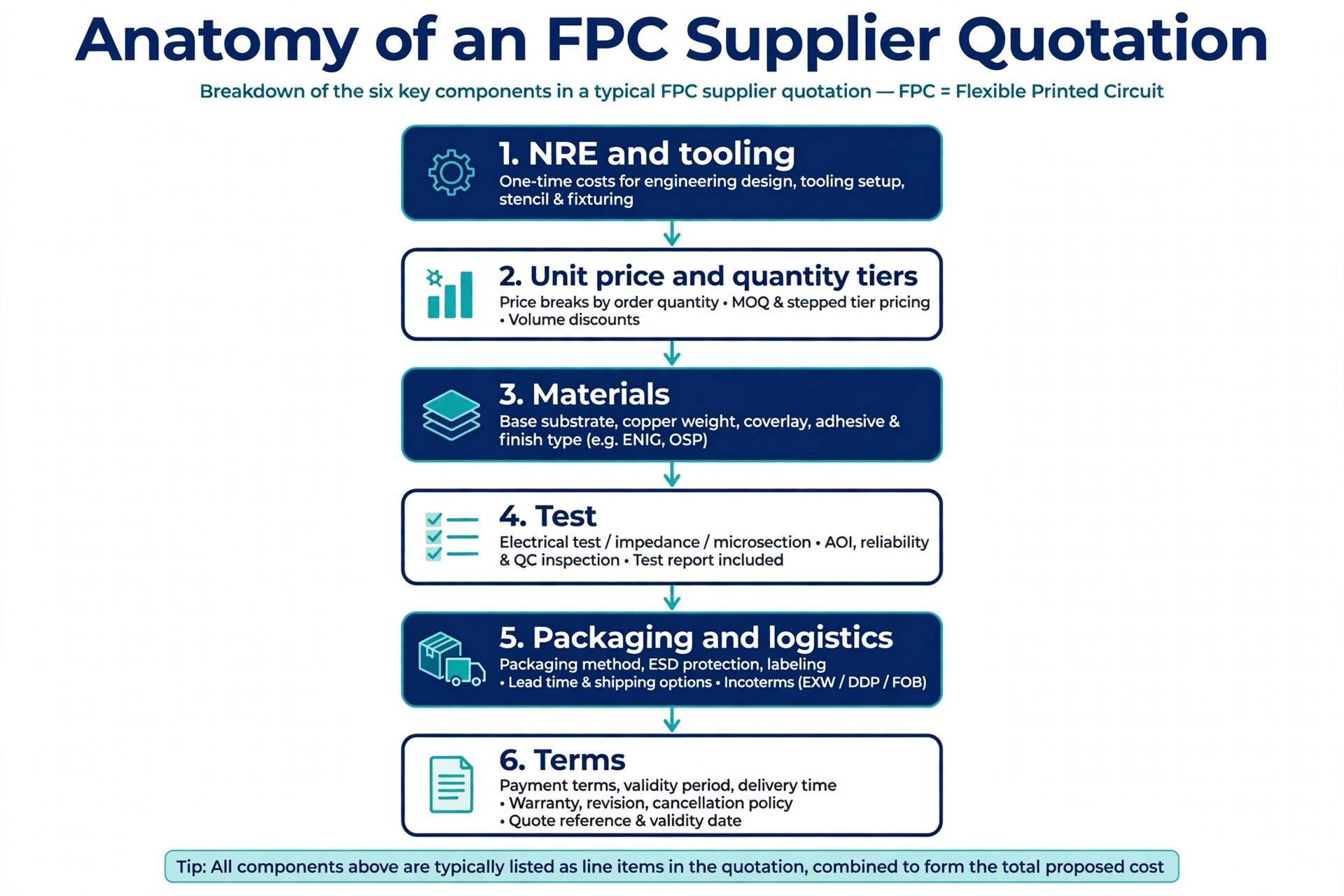
Most FPC quotations break into the same six blocks. The table shows what each block normally contains, and what to confirm inside it.
| Quotation block | What it normally contains | What to confirm |
|---|---|---|
| NRE and tooling | Engineering review, tooling, photoplots or film, test fixture design | One-off or per revision; what happens when the drawing changes |
| Unit price and quantity tiers | Price per piece at each quantity step | The exact quantity at each step, and whether the tier counts panels or finished pieces |
| Materials | Base film, adhesive, coverlay, stiffener, surface finish | Named by grade or approved equivalent, not by a generic description |
| Test | Electrical test, inspection, first-article evidence | Method, coverage, and acceptance criteria — not just “tested” |
| Packaging and logistics | Packing, labelling, shipping terms | What is included, and who carries the freight and the risk |
| Terms | Validity, payment, delivery, tax | Validity dates, payment terms, delivery point, and what tax is included |
NRE and tooling is the block most often misunderstood. A one-off engineering and tooling charge is normal on a first order; it is what pays for the review, the tooling, and the first-article work that a repeat order does not need again. What matters is whether it is charged once, whether it is charged again when the drawing changes, and whether the tooling remains usable for the next order.
Quantity tiers deserve the same attention. A tier that reads “100 pieces” can mean 100 finished pieces or 100 panels, and a panel can hold several pieces. The tier boundary also matters: a price that drops at 500 pieces only helps if the order actually reaches 500. The ten factors that move FPC cost — layer count, material, copper weight, coverlay, stiffener, finish, impedance, panelisation, inspection, and quantity — are covered in the FPC Cost Factors guide; the quotation shows how they land as money on one specific project.
Materials and finish are where a short description hides the most risk. “Polyimide FPC, ENIG finish” defines almost nothing: the film grade, adhesive system, coverlay construction, stiffener material and thickness, and the finish specification each need to be named, or the quotation cannot be held to them. When a quotation charges for a finish, the finish should be named to a specification — see the FPC Surface Finish Guide — and when it charges for copper, the foil type and weight should be stated, as the FPC Copper Foil Guide sets out.
Test is the block where a single word costs the most. “Electrical test included” can mean a flying-probe test of every net, a fixture-based test, a sample test, or a continuity check only. The quotation should name the method, the coverage, and the acceptance criteria. If it does not, the test scope is whatever the supplier assumes — and the assumption will surface at first article.
3. What Is Usually Excluded
Five charges are routinely left out of the headline unit price. Each is legitimate on its own; the problem is only discovering it after the order.
Test fixture. A dedicated test fixture is a one-off cost on many FPC projects, and it is often quoted separately from the unit price. If the quotation says “flying probe”, there is usually no fixture to pay for; if it says “fixture test”, ask whether the fixture charge is included, and whether it is charged again on a repeat order.
First-article inspection report. A first-article report — dimensions, material certificates, test records — is a deliverable, not a by-product. If the project needs it, it should be a named line with a named content, not an assumption.
Minimum order quantities on special materials. A material that is not a standard stock item can carry a minimum purchase. The quotation may price the pieces and leave the material minimum to be found later. Ask how much material must be bought, and who owns the remainder.
Expedite fees. A short lead time is often achieved by paying for it. If the quotation shows a fast delivery without an expedite line, ask whether the schedule is the standard one or an expedited one — and what happens to the price if the delivery date moves.
Packaging and shipping. Anti-static packaging, moisture protection, labelling, and freight are real costs. Silence on packaging does not mean packaging is included; it means it has not been priced.
The question to ask for each: “If this line is not in the quotation, what does it cost, and when would I see it?” The answer belongs in the quotation, not in an email thread.
4. Comparing Two FPC Quotations on the Same Scope
Two quotations can only be compared when their scopes match. Run this check before comparing any unit price: every row must be the same on both quotations, or the difference must be written down and priced.
| Scope item | Quotation A | Quotation B | Aligned? |
|---|---|---|---|
| Drawing revision | ☐ | ||
| Quantity (pieces, not panels) | ☐ | ||
| Layer count and stack-up | ☐ | ||
| Copper weight and foil type | ☐ | ||
| Surface finish | ☐ | ||
| Stiffener material and thickness | ☐ | ||
| Test method, coverage, acceptance | ☐ | ||
| Delivery date and terms | ☐ | ||
| Validity period and payment terms | ☐ |
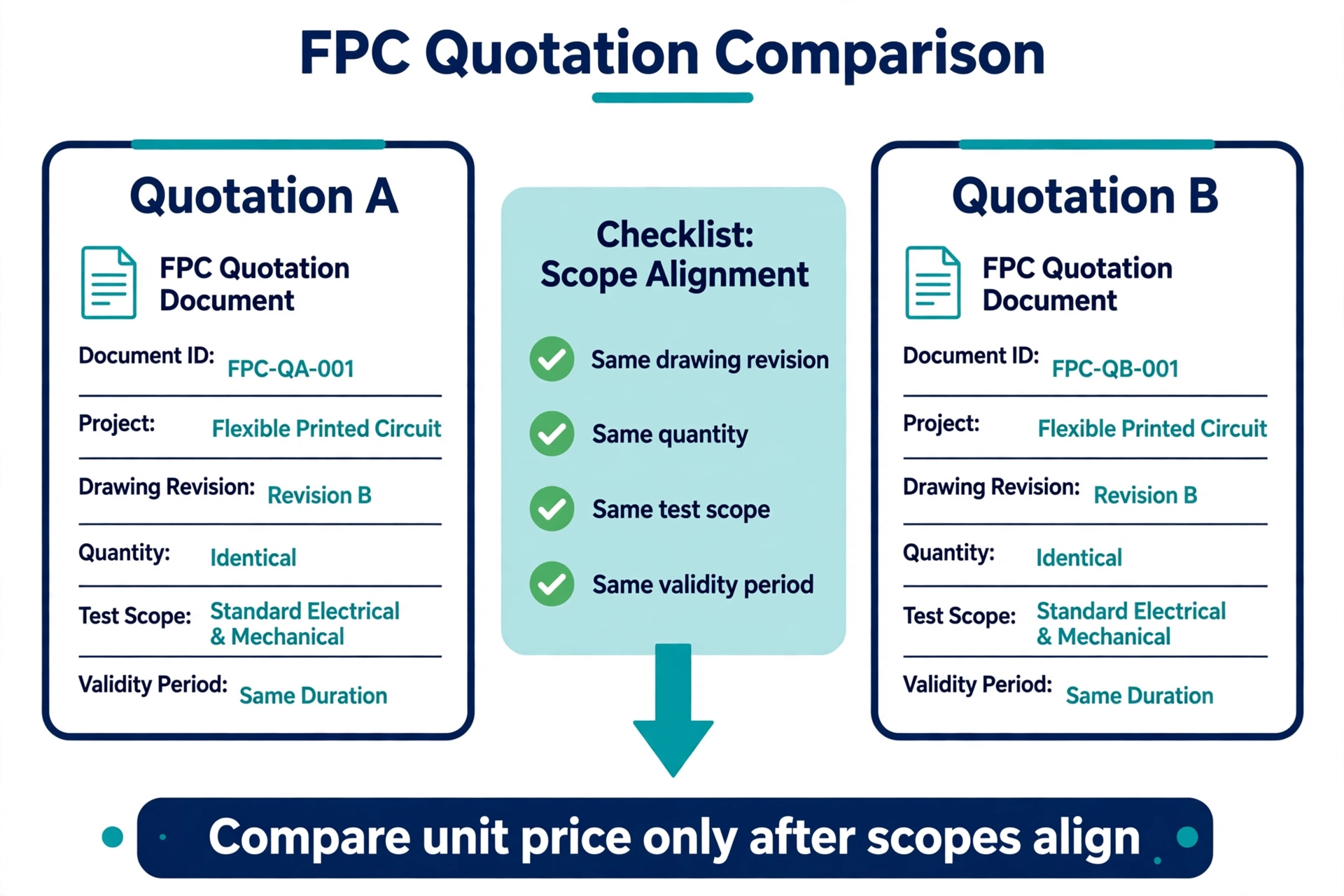
If a row differs, the quotations are not comparable yet. The work is to align the scope — ask both suppliers to quote the same drawing revision, the same quantity, the same test method — and then compare. Comparing unit prices across different scopes is the single most common error in FPC sourcing, and it is an error that only shows up in the invoice.
Send both suppliers the same one-page scope sheet — drawing number and revision, stack-up, materials, finish, stiffener, test requirements, quantities, delivery date, and validity period — and ask each to quote against it. A supplier that cannot quote against that sheet is telling you something about the scope, not about the price.
5. Worked Examples
Example A: A 100-piece pilot quotation
A 100-piece pilot run is where the structure of the quotation matters most. On a small order, the one-off charges — engineering review, tooling, test fixture — spread over few pieces, so the unit price looks high even when the total is fair. The right question is not “why is the unit price high” but “what is one-off, and what repeats”.
On a pilot, flying-probe test is usually the sensible choice: no fixture to build, and the test covers every net. A fixture test on 100 pieces would add a one-off fixture charge that the order cannot absorb. The quotation should show the test method explicitly, so the choice can be reviewed rather than assumed. The pilot quotation should also state what changes at production volume — which one-off charges drop away, and where the next tier starts — so the pilot price is not mistaken for the production price.
Example B: The quotation that looked cheap
An FPC quotation arrives with the lowest unit price of the three received. The total, however, is higher than the others. The reasons are ordinary: the test fixture was not in the unit price, the first-article report was not included, the quantity tier counted panels rather than pieces, and the delivery date assumed an expedite fee that appeared as a separate line.
None of those charges is wrong — each is a normal cost of building the scope. The error was comparing the unit price before the scope was aligned: the cheap quotation was cheap because it quoted less. Once the fixture, the report, the piece count, and the delivery terms were added, its total was the highest of the three. Neither example invents case data or specific prices; the pattern is the point.
6. Red Flags
- A low unit price with no drawing revision. Without a revision, the quotation cannot be tied to the design that will be built, and a revision change after the order can reprice the whole job.
- A very short validity period, or none at all. A quotation that expires in days leaves the price open to change before the order is placed.
- Test described only as “to standard”. A test requirement without a method, a coverage, and an acceptance criterion cannot be quoted against — and cannot be verified at delivery.
- Quantity tiers with an unclear basis. If the tier counts panels, pieces, or panels per shipment is not stated, the tier price cannot be applied to the order.
- A delivery date written as “as soon as possible”. A date without a number of days is not a schedule; it is an intention. Ask for the working days and the start point.
- A quotation that cannot be traced to a scope sheet. If the supplier cannot restate the scope in one page, it was never agreed.
7. What to Ask Before Accepting
Pre-acceptance checklist
- Drawing number and revision named on the quotation, matching the files sent.
- Stack-up, materials, finish, and stiffener named by grade or approved equivalent.
- Quantity stated in finished pieces, with the tier basis written down.
- NRE and tooling stated as one-off or per revision, with the re-charge rule on a drawing change.
- Test method, coverage, acceptance criteria, and first-article evidence named — the finished-board performance basis is IPC-6013, Qualification and Performance Specification for Flexible/Rigid-Flexible Printed Boards, and the design basis is IPC-2223, Sectional Design Standard for Flexible Printed Boards; the applicable revisions and performance class should be checked for the project rather than copied from another one.
- Packaging, labelling, freight, tax, and payment terms stated.
- Validity period stated, with the delivery date in working days from a defined start point.
- Exclusions listed explicitly: fixture, first-article report, material minimums, expedite fees, packaging.
- One governing revision, every open item listed and owned.
RFQ data to send in one package
A quotation can only be as good as the RFQ behind it. Send the data as one package — fabrication data and stack-up, assembly drawing with the mechanical layer, BOM and placement data, material and surface-finish requirements, stiffener and connector requirements, test and inspection requirements, quality agreement and traceability records, quantities, delivery expectations, and the open-item list — each with its file, revision, and owner.
The Battery Pack CCS FPC article carries the RFQ data list this article builds on, and the FPC Assembly RFQ Checklist covers the assembly-side items — BOM, placement, drawings, test, and revision control — that a bare fabrication quotation does not include.
Quantities, materials, tooling, cost, and schedule are project inputs for review, not promises of price, capacity, or lead time.
Engineering Conclusion
Reading an FPC quotation is a scope exercise before it is a price exercise. The unit price only means something when the drawing revision, quantity, materials, finish, stiffener, test method, and delivery terms match on every quotation being compared. The cheapest unit price on a narrow scope is not a saving; it is a scope that has not been priced yet.
Boundary of this guidance: no cost figure, tier, or schedule in this article is a price or a commitment. Final cost and schedule are subject to the drawing, the materials, the test scope, and the quantities of the project, and remain subject to project review.
Start an FPC Project
FPCFAB can review your FPC drawings and quotation scope, check the scope line by line, and coordinate engineering review, sourcing, quotation, and production follow-up with a project-matched partner.
To start a project, Request a Quote.